
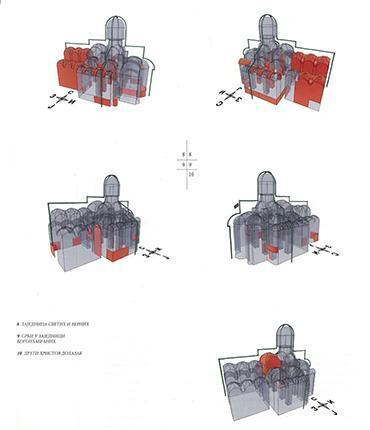
"The Dečani church is adorned with beautiful frescos which depict the entire life of Jesus Christ, Mary, the Apostles, Patriarchs, Prophets and other saints." This is how the frescos of the Dečani church were described by a Franciscan, Bonaventura da Palazzuolo, in 1637, three centuries after they had been painted.
The architectural features of the church created considerable difficulties for both the creators of the iconography program and the painters. Although the main parts of the church – the sanctuary, the nave, the narthex and the chapels – are, more or less, clearly separated from each other, some of them were unsuitable for the traditional cycle of scenes. For example, the church is extraordinarily tall and there was a “surplus” of space along the vertical axis. In the narthex, that space was easily filled by multiplying hundreds of scenes from the church calendar. In the nave, on the other hand, that space was filled with the cycle of Christ’s Life, painted in several tiers, whereas in the sanctuary it was filled with the cycle of Christ’s Miracles and Parables, extending there from the nave. The same problem related to the great height of the church also appeared in the extremely elongated lateral chapels, and it was solved in a similar manner as in the sanctuary. In the south chapel, the images from the life of Stefan Dečanski’s patron saint, St. Nicholas, occupy the upper sections of its eastern part, the closing scenes of the cycle of Christ’s Miracles and Parables extend from the nave into the west transepts of the church, atop the Akathist to the Holy Virgin, which begins in the vault of the south choir and runs all along the chapel. In the north chapel, the arrangement of themes is somewhat different: in the vaults and on the walls below them, unfold the stories of the Genesis and the Fall of Man, while below them, along the walls of the chapel runs a series of scenes from the life of St. Demetrius, to whom the chapel is dedicated.
All parts of the Dečani church were covered by necessary and appropriate themes: liturgical scenes were painted in the apses and the altar area; the chapels were decorated with the cycles of their respective patrons; the dome features an iconographic program typical of that time; almost all of the Great Feasts are depicted in the areas below the dome, and further down the walls, one below the other, there were two zones of frescos featuring Christ’s Passion, Miracles and Parables. The intention of the monastery’s founder and his advisor to based the Dečani church on the model of the layout typical of the Raška architectural school, which was more achieved through its architectural iconography rather than its construction, also extended to the church’s painted decorations. Particularly, great care was taken to ensure that the most important iconographic cycles, the Great Feasts and Passion, did not extend beyond the central part of the nave, which was conceived of as a single core nave flanked by choir transepts. Additionally, scenes from the Gospels were placed only on frontal and lateral sides of pillars, as if they had been pilasters from the Serbian 13th-century churches. It was an exception that elaborate cycles, such as the Akathist to the Holy Virgin and Christ’s Miracles and Parables, were extended into other parts of the church, the sanctuary and the south chapel, and even then they by no means interfered with the thematic integrity of those spaces.
Writers who have studied the frescos of the Dečani church sometimes note that there are many saints who were depicted several times, which they explain by the sheer size of the church. Although this is not entirely incorrect, it would be closer to the truth to say that these images are actually included into different spatial units or separate thematic wholes, in a context which not only enabled but also necessitated that they be depicted in exactly those places. On the other hand, these images sometimes represent different saints who only happen to have the same name.
Due to the great number of frescos, their reduced size, and the fragmented nature of available surfaces, one’s first impression might be that too many frescos are crowded into a small space, or even that they are chaotically arranged. However, once the key to their arrangement is found, it becomes easy to interpret and comprehend them as parts of a well thought-out system based on order and the subordination of individual parts to the whole.
Apart from a few rare, unusual examples, it would be accurate to say that the painters of the Dečani frescos conformed to a concept of the image and its place within the overall iconographic program of the church in a way similar to their predecessors from the beginning of the 14th century. They were all connected to the art of that period, though to various extents. That art immediately preceded the art of their time and it served as the source from which they were taught; they used the patterns established by that art in their own work and they transferred its spirit, slightly modified, to the walls of the Dečani church. It was an art that was closely connected with religious texts, most frequently cloaked in a liturgical form.
Individual frescos and groups of frescos in Dečani constitute a single iconographic program which shows forth the image of God as the Almighty who holds the whole world in His hands, tells the story of Genesis and original sin, then proclaims Christ’s salvific work through His incarnation, parables, miracles and Passion. It then follows the story of the founding of the New Testament Church, its consolidation and expansion by the acts of the Apostles, holy martyrs, monks and bishops, ending with a depiction of the Second Coming of Christ and the general and final salvation of humankind. In this respect, the Dečani church does not differ from other Byzantine and Orthodox Christian churches, it merely presents the mentioned themes in a more elaborate and detailed manner. It was in complete accordance with the Byzantine concept of churches and their painted decoration, according to which a church is an image of the Kingdom of God, which is depicted so as to resemble the liturgy that takes place inside the church. Christ’s incarnation and His acts on earth made it possible for people to glorify God together with the angels and saints, and in art – according to the teachings of St. Tarasius the Patriarch – this is achieved through holy images based on the Gospels that speak of God’s glory and the salvation of humankind and the world.
When the fullness of time had come, God sent His Son to Earth, who became incarnate through the Holy Virgin. His Son lived among men, taught them, gave them commandments leading to salvation, and brought them to knowledge of the true Lord. He redeemed man by His death on the Cross, by descending into hell He defeated death, was resurrected and thus paved the way for all to be resurrected from the dead, and by ascending to Heaven He promised us that He would come again and to judge all according to their deeds. However, before He died, Christ revealed the mystery of the Eucharist to us, a mystery which we partake of through communion at Divine Liturgy, and which makes it possible for mankind to return to eternal life. The Dečani paintings do not show this history of salvation in an illustrative and linear manner, in a single, continuous, temporal and spatial sequence; instead, it is revealed through the iconographic program as whole, through themes that are often intertwined in a complementary way and which are adjusted to the space in which they are located.
