
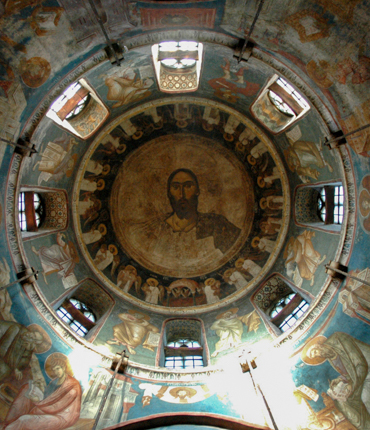
“Holy, Holy, Holy, O Lord of Sabaoth [...] Together with these blessed powers, O loving Master, we sinners also cry out and say: Truly, You are holy and most holy, and there are no bounds to the majesty of Your holiness.” High up in the church of Dečani, at the very top of the dome, there hovers a magnificent image of God depicted as Christ Pantokrator shown in waist-length (ill. 259), as He appeared to humankind. It is not a coincidence that He was painted exactly there: in medieval cosmological concepts, the dome of the church symbolized Heaven, the dwelling-place and throne of God, a heavenly Jerusalem or Zion. That is why Psalm 101(102):19–21 was written in the dome of some churches, and it is probably for the same reason that it was written in the Dečani church. It is a Psalm that glorifies God who looked down on Earth, heard the groans of prisoners and released them from death, so that they could praise Him in Zion and Jerusalem. Other prophetic texts can also be found in the dome – for example, the prophecy of Isaiah (Isa. 66:1) about Heaven as the throne of God and the earth as His footstool – as well as poetic texts, the purpose of which was to show the greatness of God and the beauty of His house. That is why the Pantokrator in the Dečani church was conceived and rendered in a very exalted manner, with attributes that unambiguously connect Him with His heavenly dwelling. The background is gold and symbolizes the heavenly light that surrounds Christ, whereas His halo and clothes are gilded with gold leaves. In His left hand, Christ holds a closed Book of the Gospels while His right hand is lifted up in blessing. Such a depiction of Christ Pantokrator had become widespread in art of the Byzantine world long before Dečani because Christ was the visible image of God, the creator and ruler of the Universe, who is glorified and praised by all heavenly powers and all people on Earth.
In a time when art and liturgy were closely related, it was easy to transition between the concepts of the Heavenly Church and the earthly Church, of Heavenly Jerusalem and the Church on Earth, of the equivalence of the service performed by angels in Heaven and that performed by priests on Earth and the resemblance of the latter to the angels surrounding God’s throne. The liturgy is full of such comparisons and they were transposed onto church walls in the form of frescoes – which is well exemplified by the Dečani church – sometimes literally, and sometimes metaphorically.
Thus, the Great Entrance with the Gospel book at Divine Liturgy is compared with the angels serving God in Heaven, with the outer form of the ritual being adopted, but not its meaning. Before making its appearance in the Dečani church(ill. 259), the Heavenly Liturgy had already passed through a long iconographic development, which can be traced from an 11th-century liturgical scroll with miniatures into the 14th century and further. Frescoes in Serbian churches clearly illustrate its development. From the Staro Nagoričino Monastery (1316–17) to Lesnovo (1342) and Dečani, it is possible to follow the remarkable efforts to understand and, with the help of liturgical ritual, to act out the Heavenly liturgy in the church. A major novelty introduced into this scene in Dečani was a continuous procession of angels and a single holy table, which bring the Heavenly liturgy even closer to the divine services in the church.
The center of the image is the Holy Table, surmounted by a canopy and covered with an antimension; it is guarded by two seraphs. The procession of angels (twenty-one in number) begins to the left of the table, whereas on its right side, the angels are welcomed by an angel at the Holy Table, who is swinging a censer and holding an liturgical fan in his hand. If we were to recognize in this image any particular moment of the Great Entrance, it would be the one when the deacon holding the Gifts, having entered the sanctuary, awaits the priest in front of the altar. This is yet another indication of the iconographic intention to represent the divine services of the Church in the Heavenly Liturgy around the altar. The procession of angels is very similar to the Great Entrance, when the Holy Gifts are carried from the prothesis through the nave and laid on the Holy Table in the sanctuary; like in the Liturgy, the angels, walking slowly, carry lit candles, censers, and tabernacles, holy water vessels, and aers, all dressed as deacons. Only angels carrying chalices or having covered patens over their heads are wearing priests’ clothing. This was the first time that priest-angels appeared in the Heavenly Liturgy, which is yet another analogy with the Great Entrance performed in church, because it was only priests who carried the Holy Gifts – or at least the chalice – during the Great Entrance. The growing similarity between the Heavenly Liturgy and the actual rite, until the distinction between them disappeared, reaffirmed the unity of the Heavenly and the earthly church and showed that both people and Heavenly powers praise God together and in the same manner.
In the Dečani church, above the Heavenly Liturgy fresco, there is an inscription with the trisagion (thrice-holy hymn): “Holy, holy, holy, Lord God of Sabaoth; heaven and earth are full of Thy glory”, a hymn which, in Isaiah’s vision (Isa. 6:3), is sung by the seraphim in eternal praise of God. Since it connects the Heaven and Earth, during the Liturgy people join their voices with the angelic forces to sing this hymn within the anaphora prayer and the hymn is just slightly modified and adapted the liturgical context. Whenever this Biblical thrice-holy hymn (as it is the case in the Dečani church) or liturgical triumphal song is written as a part of mural decoration (e.g. in the Heavenly liturgy) it is done with the idea of emphasizing the unity of people and angels in their praise of the Lord.
“Who is able to speak of the might of God?” the founder of the Dečani church asked at the beginning of his charter, since He is “the Almighty Lord and Creator of all, He who holds all creation under His rule, the Only One in eternal Light, He who abides in Three Persons, God of God, Light of Light, the Life and Giver of life, pre-eternal wisdom and power.” These words are filled with the elevated liturgical notion of God “whose power is infinite and whose glory is beyond comprehension.” That is why He, who is merciful, “who, having been without mother in the heavens, for the sake of our redemption, was born of a mother on earth without a father” came to us as “the God-Man who endured all things in His earthly life to save mankind and bring heavenly joy to primordial paradise.” However, for a long time, people, being in the grip of sin, could not see God, until Christ’s incarnation, but it did not mean that God had forgotten them: the chosen prophets saw Him in their visions, heard His words and communicated His messages and instructions to people, or they celebrated Him in words. That is why the Old Testament prophets were painted under angels in depictions of God who rules Heaven and shows Himself to humankind. Usually, their portraits were accompanied by inscriptions of their prophecies or other testimonies of God. The selection of Old Testament prophets and texts written on their scrolls were not always the same. The dome of the Dečani church features the prophets Isaiah, Ezekiel, Joel, Daniel, Jonah, Elijah, Zephaniah and Jeremiah, all of them holding unfurled scrolls (except Isaiah and Daniel) with texts that had been included in the Triodion and were read on Holy Friday and Pentecost. The Apostles were witnesses of Christ’s incarnation, with the Evangelists leaving written records about it. Accordingly, their images are always placed below the prophets, on pendentives, and they are always depicted in the process of writing their respective Gospels. That is exactly how they were depicted in the Dečani church, the only difference being that John is accompanied by his disciple Prochorus, but even this was in accordance with a tradition that had been established long before Dečani. Additionally, the visible testimonies of incarnate God were icons not-made-by-hands (acheiropoieta) – the Mandylion and the Keramidion on the pendentives on the east and west sides.
Christ’s revelation to humankind in bodily form was just a part of the divine plan of salvation, and through His incarnation, Heaven and Earth were united, as were also angels and men. According to Pseudo-Dionysius, the secret of Christ’s incarnation was first revealed to angels, who then conveyed it to people; the prophets saw it in a hidden form, whereas it was revealed to mankind through Christ’ earthly life among them. These written (Gospels) and pictorial (acheiropoieta) testimonies showed future generations His true image and made it possible for people to describe and depict Him. In the Dečani church, an imaginary line at the height of the pendentives separates two worlds, Heaven and Earth. Accordingly, Archangels Michael and Gabriel, who were painted there in medallions, with scepters and spheres in their hands, should be interpreted as guardians of the Kingdom of Heaven and as its messengers who told humankind about it.
