Among the church’s most valuable sculptures are the figures on the consoles of the friezes of the blind arcades below the final corniches. Here we find women’s heads with braids, scarves and loose hair, followed by the heads of bearded men, along with various contorted human figures, birds, griffins, both imaginary and domestic animals, dragons and also a number of quite diverse leaf motifs. Combining a diverse artistic repertoire with high quality craftsmanship, the church’s sculptures reveal a unique beauty rooted in medieval principles of aesthetics.
The Church of the Ascension of Christ’s sculptural ornamentation scheme is clearly formally arranged according to the principles of Romanesque art, while at the same time it clearly expresses the universal Christian understanding of the essence of perfection and beauty within the entirety of the visible world. Or, to make use of the words of Dionysius the Areopagite, the Church shows how all beings and all nature were created in the glory of the Creator. Together with the carved motifs on the structural parts of the interior of the church, the architects created a conceptual unity out of a complicated transferring of significance, whereby the scenes presented conformed with the actual purpose of the area on which they stood. The compiling of the iconographic subjects of the church’s sculptures was done under the direction of Archbishop Danilo II, who, from what we can conclude based on his own written works, was inspired by the Gospels, Psalms, and the writings of the Prophets and Apostles. Thus, Dečani’s sculptures illustrate both biblical parables and cautionary tales, while numerous representations of various animals and beasts, as well as fantastic beings have symbolic meaning, conveying basic moral lessons.
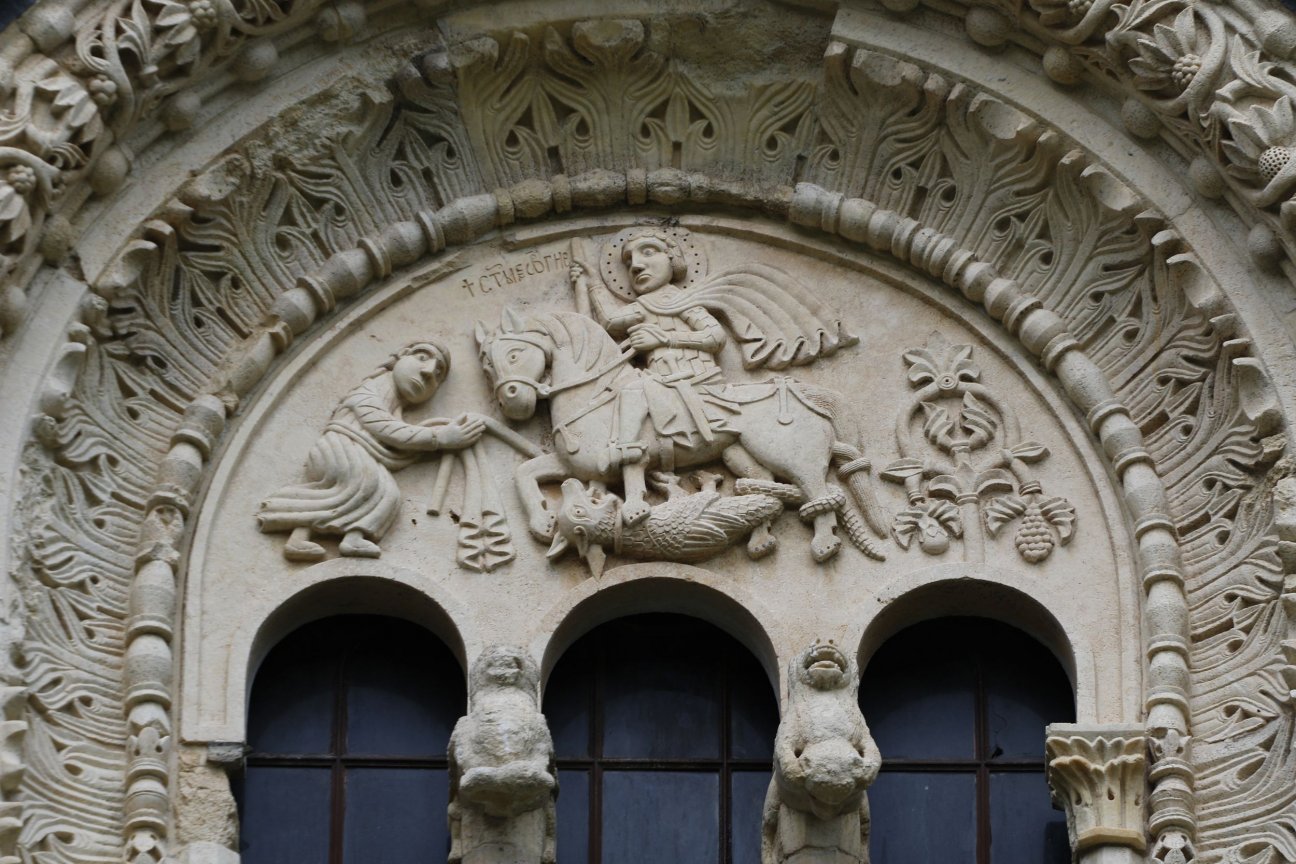
The sculptures themselves create a sort of topographic symbolism based on where they have been placed within the entirety of the church, and this symbolism is not the same throughout the building. At the main entrance, the main regions of the universe are displayed in concentric circles, in which the north side usually represents the power of darkness, while the south contains positive symbols. Scenes are also divided between right and left, where the right side is that of the righteous. The most numerous are the symbolic images of good and evil in which good wins, as in the representation of St. George killing the dragon in the tympanum of the west triple lancet windows. In addition to the images of flora and fauna bearing metaphorical significances, there are also some scenes from the life of Christ, including a scene of Christ’s baptism in the tympanum of the south entrance, as well as a scene of the Last Judgment. It was placed in the tympanum of the main entrance with a representation of Christ the Judge and Almighty God on His throne at the time of His Second Coming, as described by the Evangelist Matthew.
The sculptural theme on the east triple lancet window is very complex. Its main conceptual motif is a quatrefoil in the middle of the tympanum, interpreted as the representation of the four elements or the tree of life, while its sides represent the sufferings of hell, while the reliefs on the sides of the triple windows have been understood as images of sins and virtues.
The full-scale sculptures by the entrances and triple windows have a special meaning, demarcating the line between the sacred and the profane, and acting as gate keepers. Together with the freestanding sculptures on the facades and the motifs on the consoles of the arcade friezes, they constitute an important piece of the conceptual unity of Dečani’s sculptural ornamentation, whose primary aim is is to praise the Creator of nature, as stated by Psalm 148, which invites all living things, trees and hills to praise the name of the Lord.