
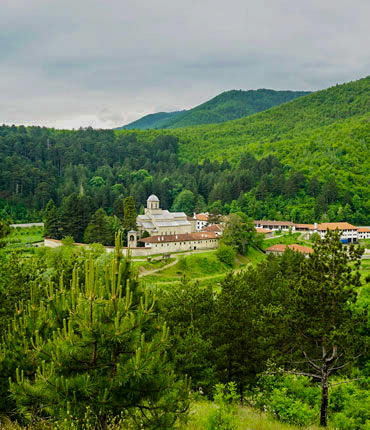
"Whilst visiting many and diverse places in my region, I found a place in the area of Hvostno called Dečani... adorned with every type of tree, for it is a place lush and fertile, and also flat and grassy, and the sweetest waters flow there from every direction; and abundant natural springs surface there and it is watered by a crystal clear river... it is enclosed from the west by the highest of mountains and their steep slopes, and hence the air there is wholesome. A large field adjoins to the east, which is irrigated by the same river. Such a place is, therefore, good and apt for the construction of a monastery". - This is how Grigorije Camblak described the choosing of a site for the construction of this monastery which was a gift from the royal family. It was to be in the shadow of the Prokletije Mountains, between Peć, the seat of the old Serbian Archdiocese, and Prizren, one of the famous capitals of the Nemanjić dynasty. The monastery estate was enormous, consisting of continuous territory extending from the Beli Drim River in the Prizren Valley in Metohija to Komovi on the present Montenegrin border, and from Peć to the Valbona River in Albania with separate holdings in Polimlje, Drenica, near Prizren and the Bojana River.
St. Sava himself had chosen the Monastery’s location, on the right bank of the Dečanska Bistrica River in the parish of Zatrnava. The Monastery is situated perfectly on the edge of the fertile Metohija plateau, then covered with forests of domestic chestnuts and tall fir trees. The plains on the southwest side of the Monastery transform into a gorge that rises to the gray peaks of the Prokletije Mountains, the natural border separating Old Serbia from Albania.


