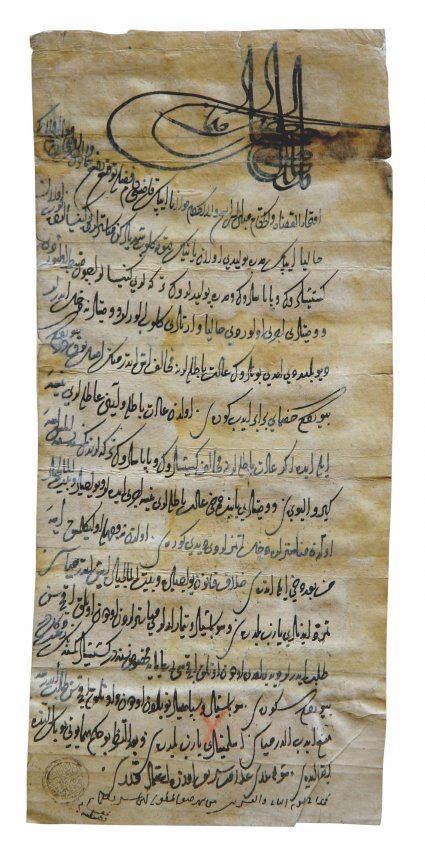
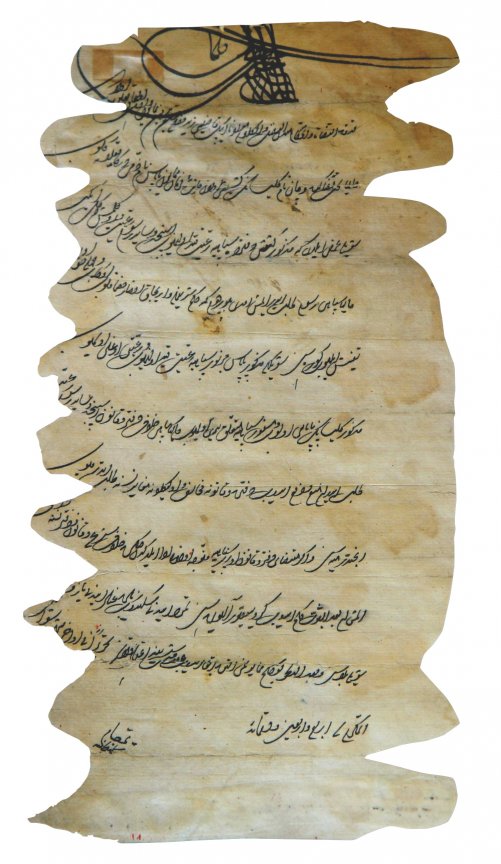
The Monastery finally fell under the Ottoman rule in 1455 and would remain a part of the Ottoman Empire until the beginning of the twentieth century. Although many of its landholdings were taken away, the Monastery retained important privileges and won the favor of Ottoman sultans; according to imperial edicts (fermans), the abbots held the status of sipahis (feudal lords) and imperial falconers. As a result of these titles, the Monastery was protected by the laws of the Ottoman Empire and it was not required to pay tax on its property; the abbot also had the right to an armed escort when he traveled. The provisions of the law, however, were frequently no obstacle to local Ottoman feudal lords in committing various acts of violence against the Monastery; consequently, the Dečani monks were forced to exert many efforts to preserve the Monastery and its sacred relics.
Numerous old Serbian records and Ottoman fermans secured by various Dečani abbots from the Sultan in Istanbul tell us about the difficulties the Monastery faced. Ottoman historical sources prove that violence and appropriation of Monastery property became more frequent in the second half of the sixteenth century when the demographics of the villages around Dečani changed. Serbs who had converted to Islam and immigrants from the Albanian mountains mercilessly attached the unprotected monastery land without regard for the Serbian Christian monastery. Hundreds of preserved orders, court verdicts of sultans and Islamic judges as well as many records in books and testimonies of monastery visitors show that year after year, the difficulties in which the Dečani monks found themselves only multiplied. At the same time, the restoration of the Peć Patriarchate (1557) brought about a creative impetus in the life of the Monastery: printed liturgical books were obtained, and a large cross and royal doors were made for the iconostasis. The well-known works of Monk Longin of Dečani, who painted icons and wrote ecclesiastical poetry, came into being at this time.
The Austrian Army’s wars with the Ottomans and occasional rebellions against the Ottoman rule in the Balkans ended with terrible acts of vengeance against the Serbian population and massive migrations of Serbs from Kosovo and Metohija to the north, across the Sava and Danube Rivers, the largest of which took place in 1690 and 1739. Visoki Dečani was not spared from looting and burning of its buildings, as well as the torture and murder of its monks. The monastery brotherhood, led by courageous abbots full of zeal and love for the holy shrine, constantly sought to protect what it had inherited from the founders. Veneration for the Holy King of Dečani survived even during this time, even among many non-Orthodox Albanians. Various miracles are confirmed in written records in which St. Stefan helped the destitute, protected the people and his endowment, and punished those who dared attack the Monastery.